AI Voice Bot for Closing Deals
How an AI sales voice bot spots buying intent, handles objections, and connects to your CRM to close deals with control and measurable results.
An AI voice bot can close deals, but only when it works within a clear sales framework: a defined offer, known qualifying questions, recurring objections, and one clear closing action. In simple terms, it is not an automatic replacement for every salesperson, but a highly effective engine for fast calls, warm leads, service renewals, and consistent follow-up that doesn't fall through the cracks.
What exactly is an AI voice bot for closing deals?
A voice bot for sales is an AI agent that conducts a live phone conversation, understands open-ended answers, asks follow-up questions, pulls information from business systems, and leads the customer to the next step. That next step can be booking a demo, collecting a deposit, renewing a subscription, approving a quote, or intelligently handing off to a human rep at the right moment.
The main difference between such a bot and old IVR is not just speech quality, but the ability to hold a contextual conversation. If you want a broader background on the basic capabilities in this space, see the article on Hebrew AI Voice Bot for Business Phone Agents. And if you want to understand where the line is between simple automation and an agent that makes decisions during a conversation, it is also worth reading AI Agent vs. Chatbot: What's the Difference in Practice.
The important point for business owners: a voice bot for closing deals is not measured by how 'human' it sounds, but by how many quality conversations it moves toward a real business action.
When does a voice bot actually know how to close a deal?
The common mistake is to think every sales process is suitable for voice automation. In practice, a voice bot succeeds when the sale meets four conditions:
- The offer is clear — a product, service, or entry package that is easy to explain in one sentence.
- There are fit criteria — for example budget, urgency, location, customer type, or a defined need.
- The objections are predictable — "It's too expensive," "I need to think about it," "Send it to me on WhatsApp," "Call me tomorrow."
- There is a defined closing step — a demo, payment, deposit, meeting, or handoff to a closing rep.
In other words, how does a voice bot close a deal? Not through magic, but by shortening response time, keeping the conversation consistent, and quickly filtering out the people who are actually ready to move forward.
In many cases, it is worth adding a warming layer before that. For example, a lead that responded to an ad, opened an email, or filled out a partial form is an excellent candidate for an automated follow-up call. In this context, the article on AI Agent for Lead Warm-Up in Sales completes the picture nicely.
Which sales scenarios suit a sales voice bot, and which do not?
Not every sales funnel should start or end with an automated call. Here is a practical rule of thumb:
| Sales scenario | Voice bot fit | Why |
|---|---|---|
| Following up on form leads within minutes | High | Fast response increases the chance of contact |
| Renewing an existing subscription or service | High | The customer already knows the offer and the brand |
| Scheduling a consultation or demo | High | The closing step is clear and easy to measure |
| Collecting a deposit or payment link | Medium-High | Good when the process is secure and the offer is standardized |
| Complex B2B sales with several approvers | Low | Deep customization and human negotiation are needed |
| Very expensive product or custom service | Low-Medium | The bot is good for qualification and preparation, less for full closing |
The implication is that a sales voice bot excels especially in the middle and at the end of the funnel when the decision is relatively short. It is less suitable for deals based on long-term trust building, complex fit, or creative negotiation.
How does a voice bot close a deal in practice?
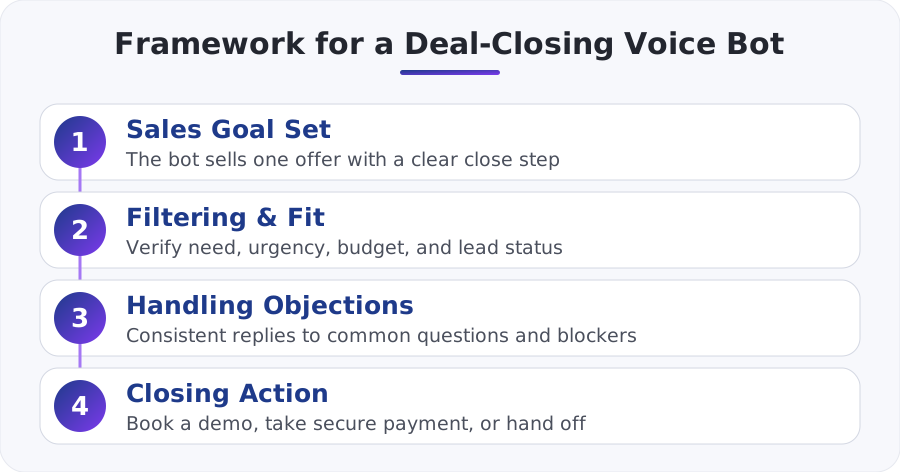
For a voice bot to close deals, it needs to perform a precise sequence of actions, not just 'talk nicely.'
1. Very fast outreach
The biggest advantage of an AI agent for a sales desk is availability. A lead that just left details is worth more than a lead you call back three hours later. At this stage, the bot verifies it reached the right person, reminds them of the source of the inquiry, and asks permission to continue.
2. Filtering and fit
The bot asks 3 to 5 questions that clarify whether it is worth continuing. For example: whether the customer is looking for an immediate solution, the approximate budget, whether the decision is personal or organizational, and what outcome they want. This is where the real operational advantage is built: sales reps do not waste time on unqualified leads.
3. Handling predictable objections
A voice bot does not need to answer every question in the world. It needs to answer very well the ten objections that keep coming up again and again. For example: price, start time, support model, cancellation options, rep availability, or what is included in the first step.
4. Leading to one closing action
This is where most projects fail. If you try to make the bot present, persuade, negotiate, collect credit card details, and handle every exception too, you will get a fragile process. Instead, it is better to define one closing action: book a meeting, send a payment link, collect a secure deposit, or hand off to an available rep who already sees the conversation summary on screen.
A simple numerical example: a business that receives 200 leads per month and spends an average of 6 minutes on the first screening call burns about 1,200 minutes, or 20 working hours. If the bot handles the screening and passes only 60 qualified leads to a rep, the human screening time drops to about 6 hours, even before we measure the improvement in response speed.
How do you connect the bot to the CRM and other systems without a mess?
The bot should not be just another disconnected channel. To really close deals, it must be connected to the systems that already run the business: CRM, calendar, quoting system, payment system, and sometimes even WhatsApp or email for follow-up.
On the technical side, solutions like this usually rely on a real-time voice layer and a telephony provider. For example, OpenAI documents live voice workflows in the Realtime API, and telephony providers like Twilio Voice make it possible to route, record, and run calls programmatically.
In practice, the right integration is made up of five components:
- Lead source
- Voice conversation engine
- Access to CRM data and offers
- Business logic for deciding when to hand off to a rep
- Full recording of the call outcome
If you are building a process like this, it is important that the integration is not ad hoc. The article on How to Connect Business Systems via API Using n8n and Make explains the connection layer, and the article on Connecting CRM, WhatsApp, and Invoices Without the Mess clarifies how to avoid a scattered architecture that will break after a month.
How do you measure the success of a voice bot for closing deals?
The wrong metric is 'how many calls the bot made.' The right metric is business progress along the funnel.
These are the KPIs that really matter:
- Call answer rate
- Rate of calls that reached full screening
- Qualified lead rate
- Rate of handoff to a rep or meeting booking
- Meeting attendance rate
- Payment or deposit rate from the calls
- Lead response time
- Rate of calls where the bot failed and handed off to a person
At this stage, you also need to talk about costs. A voice bot can be very profitable if it replaces repetitive work or increases response speed, but not every business needs one on day one. Before deciding on a project, it is worth understanding the cost structure in the article How Much Does an AI Voice Bot Cost for Businesses?.
What risks do you need to manage in advance?
There are four risks business owners tend to underestimate:
Compliance and payments
If the conversation reaches a payment stage, you must define a secure and compliant path. In many cases it is better for the bot to send a payment link or hand off to a dedicated collection environment, rather than gathering card details freely. For regulatory background, see the PCI DSS standard.
Answer accuracy
A bot that is not connected to the right data may promise things the business does not actually provide. That is why it needs to be limited to offers, prices, dates, and policies that have already been approved.
Escalation at the right time
If the customer asks an unusual question, sounds angry, or requests a discount that was not defined, the bot needs to know to stop and hand off to a rep. That is not a failure; it is proper control.
Governance and permissions
Who approves the bot to offer a promotion? Who decides when it can send a payment link? Who checks problematic calls? These are operational governance questions, not just technology questions. If you are building an agent that operates on a real sales process, also read AI Governance in Business: Who Approves Agent Decisions and Automations.
The bottom line
A voice bot for closing deals is not a gimmick, but it is also not a 'digital salesperson' that can close every deal for every customer. It is excellent when it operates on a focused process: warm leads, screening calls, familiar objections, and one closing action that is easy to measure.
If you are considering bringing a voice bot into sales, the first question is not which voice model to choose. The right question is: Where in the funnel do we have repetitive calls with clear business value that can be turned into a measurable and controlled process? That is where, and only where, an AI voice bot really starts closing deals.
Related pages
What wears you out most in your business? Pick one and we'll start there
One click, and the form is already partly filled in.