How Much Does a Hebrew AI Voice Bot Cost?
How much does a Hebrew AI voice bot cost? A breakdown of pricing, realistic SMB ranges, pricing models, ROI, and key questions before quoting.
For most SMBs in Israel, the cost of a Hebrew AI voice bot is not one number but a combination of setup, a fixed monthly component, and usage cost based on call volume. In practice, a small or medium-sized business will usually see a range from a few thousand shekels for a basic solution to tens of thousands for a richer solution with integrations, control, and complex flows.
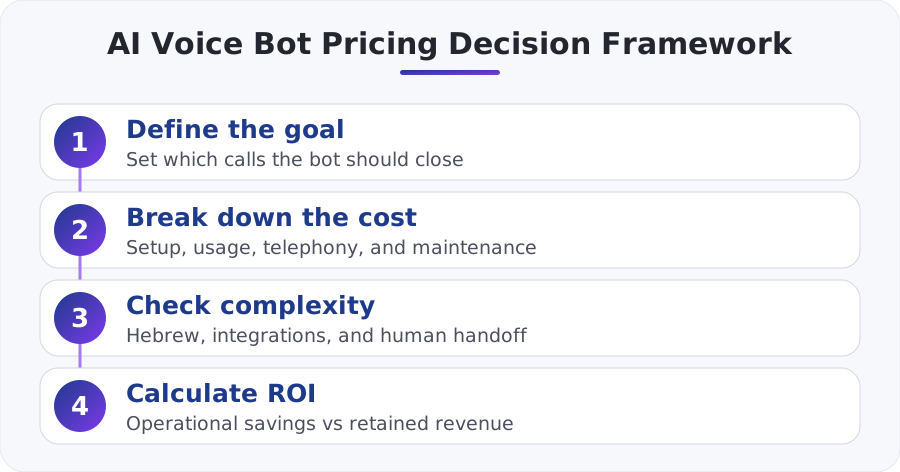
What Really Determines the Cost of an AI Voice Bot?
The common mistake is to ask only how much a voice bot costs instead of asking what the bot actually needs to do. A bot that answers common questions is very different from an AI phone agent that identifies a customer, opens a ticket in the CRM, schedules a meeting, and transfers to a representative only when needed.
These are the main cost components:
1. Setup and Scoping Cost
This includes scenario mapping, call flow definition, business logic building, system integrations, testing, and improvement. The more exceptions, edge cases, and decision points there are, the more expensive the setup becomes.
2. Fixed Monthly Subscription
This usually covers maintenance, monitoring, ongoing improvements, logs, the automation environment, and sometimes a basic usage allowance. If the solution is managed by a vendor, this is also the price of operational availability, not just software.
3. Usage Cost
This is where the technology components themselves come in: telephony, speech recognition, voice generation, and the language model. Different vendors price this differently, but usage-based pricing is standard. For example, model pricing varies by provider and volume in OpenAI API pricing, telephony costs are listed by cloud providers such as Twilio Voice pricing, and speech recognition services are also officially priced by usage, such as Google Cloud Speech-to-Text pricing.
4. Hebrew Quality and Voice Experience
Good business Hebrew is not something to take for granted. If you need a natural voice, understanding of names, phone numbers, addresses, and smooth switching between spoken language and business language, the price goes up because more testing, more tuning, and more controls are required.
5. Integrations and Business Policy
The deeper the bot is connected to the business, the greater its value and also its cost. Connecting to a calendar, CRM, phone system, invoicing platform, or ERP adds work. If you are before that stage, it is worth understanding what is involved in how to connect CRM, WhatsApp, and invoicing without the mess.
If you are still figuring out whether you even need a voice bot or a simpler system, it is worth reading about the practical difference between an AI agent and a chatbot, because that distinction directly affects the budget.
Which Pricing Models Are Common?
In practice, you will see three main models, and sometimes a combination of them:
| Model | What you pay | Advantage | Drawback | Best for |
|---|---|---|---|---|
| Setup + fixed monthly fee | One-time project and ongoing subscription | Predictable and easy to plan | Sometimes does not reflect actual usage | Businesses with stable volume |
| Pay per use | Based on minutes, calls, or interactions | Flexible in early stages | Harder to forecast monthly cost | Pilots or seasonal demand |
| Hybrid model | Fixed base + variable usage | Good balance between stability and flexibility | Requires careful reading of the proposal | Most SMBs |
In most cases, the hybrid model is the healthiest for a business: a base price that covers reasonable operations, and a variable component that allows growth without overpaying when volume is low.
What Does It Actually Cost for a Small or Medium Business?
Here are realistic ballpark figures for the SMB market in Israel. These are not fixed list prices, but typical ranges seen in the market depending on complexity.
Basic Voice Bot
- Setup: about NIS 4,000 to 10,000
- Monthly: about NIS 700 to 2,000
- Suitable for: first-line response, FAQs, collecting details, call routing
Operational Voice Bot with Business Logic
- Setup: about NIS 10,000 to 25,000
- Monthly: about NIS 2,000 to 6,000
- Suitable for: appointment setting, detail verification, opening a case, lead filtering, smart transfer to a representative
AI Phone Agent with Deep Integrations
- Setup: about NIS 25,000 to 60,000
- Monthly: about NIS 5,000 to 12,000
- Suitable for: service center, inbound sales, collections, connection to CRM, ERP, and operational systems
What makes it especially expensive?
- How many systems need to be connected
- How many exceptions the process has
- Whether the bot needs to perform an action, not just answer
- Whether SLA, monitoring, and operational resilience are required
- Whether a proper handoff to a human representative is needed
Anyone who wants a better understanding of what such a solution includes in terms of capabilities, not just price, can go deeper in the article about Hebrew AI voice bot for business phone agents.
How Do You Calculate Voice Bot ROI?
This is the right question, more than how much it costs. Price matters, but a good business decision is measured by ROI.
Simple formula:
ROI = Operational savings + retained or generated revenue - total monthly cost
Practical Example
Let's take a private clinic that receives 1,200 incoming calls per month.
- 300 of the calls come after business hours
- 180 calls are abandoned or unanswered during busy hours
- Average human handling time for a simple call: 3 minutes
- Estimated total labor cost: NIS 1.4 per minute
- The bot handles 660 calls automatically per month
The operational savings alone are: 660 × 3 × 1.4 = NIS 2,772 per month
Now let's add retained revenue: if, out of the lost calls, the bot manages to bring back only 25 appointments per month, and each appointment is worth NIS 180 in contribution to the clinic, that is another NIS 4,500 per month.
Total monthly value: NIS 7,272.
If the system's monthly cost is NIS 3,200, and a setup cost of NIS 12,000 is spread operationally over 12 months, the effective monthly cost is NIS 4,200. In that case, there is still positive value of NIS 3,072 per month, and the investment pays back in less than four months.
This is just one example, but it shows the principle: in most cases, the big value of an AI voice bot is not only labor savings, but preventing lost calls, shortening response times, and improving availability.
Before you buy, it is also worth checking how to identify a process that is suitable for automation, because not every type of call justifies the same level of solution depth.
When Is the Cheap Price Actually Expensive?
A low offer can be a great deal, but sometimes it simply shifts the real cost to you later.
Common warning signs:
There Is No Clear Definition of Success
If it is not defined what counts as a successful call handling, how abandonment is measured, and what the transfer rate to a representative is, it is hard to know whether the system is even working.
There Are No Logs, Recordings, or Monitoring
Without transparency, there is nothing to improve. A voice system should allow call review, fault identification, and flow optimization.
There Is No Handling of Exceptions
Ask what happens when the customer mumbles, changes their mind, asks an unexpected question, or provides an invalid phone number. That is where the system is truly tested.
There Is No Real Integration
A bot that does not write back to the CRM, does not update status, and does not document the call creates double work. Sometimes a tailored solution is better than a rigid off-the-shelf product; in that context, it is worth reading when n8n beats an off-the-shelf solution.
There Are No Decision Boundaries
If the agent can approve, reject, change, or schedule a business action, you must define who approves what. This is not only an operational issue but also a matter of accountability, as detailed in the article on AI governance in business and approval of agent decisions.
How Do You Ask for the Right Quote?
To compare vendors, ask for a quote that breaks the project into 5 layers:
- Scoping and setup
- Telephony and numbers
- Use of voice and AI engines
- Integrations with existing systems
- Maintenance, improvement, and monitoring
In addition, require clear answers to these questions:
- How many simultaneous calls does the system support?
- Who is responsible for monitoring and fixing issues?
- What is included in the price and what is billed by usage?
- How is success measured after 30 and 90 days?
- What is the realistic implementation timeline?
- What does the handoff to a human representative look like?
- What happens if you want to expand the bot to additional channels later?
This is an important point: if you later add WhatsApp, the website, or CRM, it is better to think about the architecture now so you do not pay twice for the same business logic.
Bottom Line
The price of a Hebrew AI voice bot for businesses depends less on the technology name and more on the business value it is supposed to create. For a small business with a focused need, the cost of a Hebrew voice bot can start relatively low; for a business with integrations, SLA, and complex service or sales processes, AI phone agent pricing rises accordingly.
The right way to make the decision is not to look for the cheapest price, but to break the proposal into cost components, understand what the bot closes end to end, and check voice bot ROI based on calls saved, calls that do not get lost, and revenue retained. If you are given a price without talking about process, measurement, and integrations, you probably have not received a real quote yet.