AI Lead Nurturing Agent for Sales
See how an AI lead nurturing agent qualifies prospects on WhatsApp, syncs with CRM, and hands off only ready leads to sales.
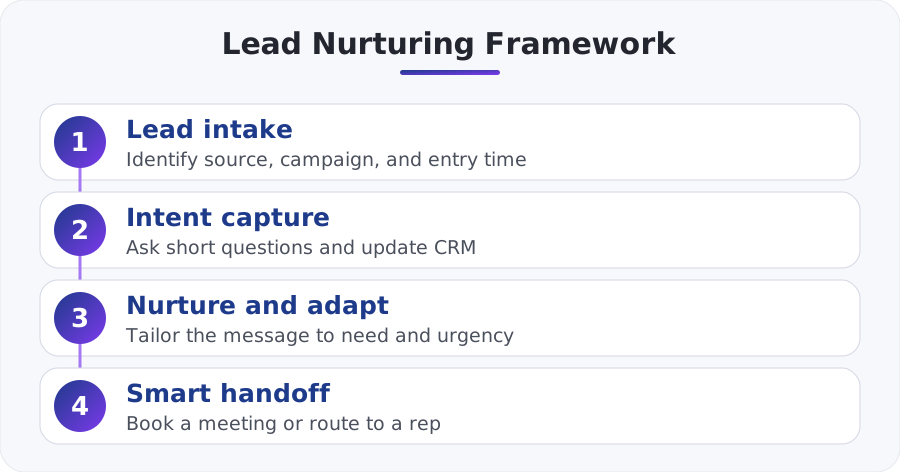
An AI lead nurturing agent is a mechanism that responds instantly to an inquiry, asks a few short questions, adapts the message to the lead’s context, and pushes it to the next stage — a meeting, a sales call, or a handoff to a representative. When it’s connected to WhatsApp and the CRM, it reduces lead leakage, shortens response times, and improves the quality of the information the salesperson receives before the call.
What Is an AI Lead Nurturing Agent and How Is It Different from a Chatbot?
Lead nurturing is not just about “replying fast” and not just about “filtering relevance.” The goal is to keep the prospect’s intent alive, collect missing information for the sale, identify urgency, and move the conversation to the next step without overloading the team.
A good AI agent does not work like a rigid “press 1 / press 2” script. It reads the context: where the lead came from, what they wrote, what is already known about them in the CRM, and what next move the business wants to promote. If you are still checking whether the solution you are considering is really an Agent or just an upgraded menu, it is worth reading the explanation of the practical difference between an AI agent and a chatbot.
The practical difference looks like this:
| Capability | Rigid chatbot | AI lead nurturing agent |
|---|---|---|
| Understanding free text | Limited to expected questions | Understands open wording and context |
| Information collection | Only by fixed fields | Asks follow-up questions and fills missing fields |
| Message adaptation | Same wording for everyone | Different message based on source, need, and urgency |
| Routing to a rep | Manual or basic | Based on rules, lead score, and conversation context |
| Continuing the conversation | Breaks easily | Can continue and summarize the next step |
In simple terms: an AI lead nurturing agent is not supposed to “close” instead of a salesperson. It is supposed to prepare the ground so the salesperson gets a more mature lead, with less friction and less wasted time.
When Does a Business Really Need Lead Nurturing Automation?
Not every business needs this on day one. But there are several clear signs that it is time:
- Leads come in at night, on weekends, or when the team is unavailable.
- The initial response time is long and inconsistent.
- Reps waste time on repeated opening questions.
- Leads arrive from multiple sources, but the information is spread across WhatsApp, forms, and the CRM.
- It is hard to tell who is a hot lead and who is just checking things out.
In an Israeli SMB, the problem is usually not a lack of leads but a loss of momentum. A lead who left their details after a campaign and only sees a response two hours later or the next day is already in a different state: they may have already contacted a competitor, forgotten the context, or lost interest. This is where lead nurturing automation creates immediate value.
What Does Lead Nurturing on WhatsApp Look Like in Practice?
In practice, lead nurturing on WhatsApp works best when it is short, natural, and goal-oriented. You do not run an endless interview; you do move the conversation one step forward.
A concrete example: a lead comes in at 10:14 p.m. from a “demo for sales system” campaign and leaves a message: “Hi, I need a solution for a team of 12 users.” Instead of waiting until morning, the agent can reply within a minute: “Great. To point you in the right direction — is this for sales only or also customer service? And are you already working with an existing CRM?” If the lead replies, “Sales only, we use monday,” the agent can already update fields in the CRM, identify fit, and suggest a morning meeting slot.
This is exactly where WhatsApp excels: fast, personal, and usually with a higher open rate than email. But it is important to work with the platform correctly. According to the official WhatsApp Business Platform documentation, opt-in, the conversation window, and business-initiated template messages all matter. Therefore, a good nurturing process does not start with the question “what prompt should we write?” but with “at what stage are we allowed to send what, and to whom?”
If you are building such a process on WhatsApp, it is also recommended to understand the broader framework of WhatsApp as a business platform for automation and customer service, and not look only at the bot itself. In addition, in most cases the real value comes from the connection between the conversation and the data, so it is important to see how a WhatsApp bot and AI agent connect to CRM in Israeli businesses.
How Do You Build an AI Lead Agent Without Creating Chaos?
The common mistake is to start with the technology. The right way is to start with operational decisions.
1. Define What a “Hot Lead” Is
Before automation, you need a definition. Is a hot lead someone who asked for a demo? Someone who mentioned a budget? Someone who wants to start next month? Without a definition, the agent will only create noise.
It is worth deciding in advance on only 3 to 5 nurturing signals, for example:
- Time urgency
- Team size or usage volume
- Existing system
- Clear business pain
- Willingness to schedule a call
2. Build a Short, Non-Intrusive Conversation Layer
An AI lead nurturing agent does not need to ask ten questions. In most cases, two good questions are enough to know whether to transfer to a rep, send materials, or move into follow-up. If you overload it, you lose the conversation.
A good rule: each message should advance only one decision.
3. Send Clean Data Back to the CRM
The value of the agent is measured not only in the conversation itself but in what remains after it: status, summary, CRM fields, lead source tags, and a trigger for the next step. To do this reliably, it is better to force the AI model to return a fixed data structure instead of free text; that is exactly the purpose of Function Calling in OpenAI’s documentation.
In practice, the basic fields worth returning are:
- Lead source
- Primary intent
- Urgency
- Relevant product or service
- Main blocker
- Whether a meeting was booked
- Whether human approval is required
4. Define Handoff Rules for the Salesperson
This is where most projects fail. If there are no clear handoff rules, the lead is either transferred too early or too late.
For example:
- If the lead asks to speak now — transfer immediately.
- If a high fit is identified but there is no availability — offer to schedule a call.
- If there is interest but no readiness — move to an automated follow-up path.
- If it is an unsuitable inquiry — close politely and do not overload the team.
5. Choose Infrastructure That Fits the Business, Not the Other Way Around
A small business with a simple process can get started quickly. A business with multiple lead sources, an existing CRM, and different logic by product will need a more flexible automation layer. If you are deciding between a ready-made solution and a custom process, read when n8n beats an off-the-shelf solution. And if your data is spread across several systems, it is better to fix the foundation first through connecting CRM, WhatsApp, and invoices without the mess.
Which Metrics Must You Measure?
If you do not measure, you do not know whether the agent is nurturing or just talking. The metrics that really matter are operational and sales-related:
- First response time
- Percentage of leads who received a response within the target window
- Percentage of leads who replied to the first message
- Percentage of leads who reached the call-booking stage
- Percentage of handoffs to a salesperson out of all conversations
- No-show rate for meetings booked through the agent
- Quality of the information in the CRM after the conversation
The most misleading metric is “how many messages the agent sent.” That is not interesting. What matters is whether the conversation moved the lead to a better state than before they entered.
What Are the Common Mistakes in WhatsApp Lead Nurturing?
The first mistake is thinking that an AI agent is just well-written messaging. In practice, the value lies in the logic: when to ask, when to stop, when to transfer, and what to write in the CRM.
The second mistake is giving the agent too much freedom. Lead nurturing is a semi-structured process: there is room for a natural conversation, but there must be clear boundaries, defined fields, and exit scripts.
The third mistake is ignoring the link between marketing and sales. If the sales team does not trust the summary the agent passes along, or if marketing does not correctly tag the campaign source, the agent will work with weak data and return weak results.
The fourth mistake is measuring success too early. In the first week, you check operations: replies, fields, transfers. Only afterward do you look at meetings, proposals, and closes.
The Bottom Line
An AI lead nurturing agent is not just another bot that replies automatically, but an operational layer that connects response speed, intent understanding, information collection, and smart handoff to sales. For an Israeli business working with WhatsApp, campaigns, and a CRM, this is usually the place where you can create a fast improvement without replacing the entire sales system.
If you build the definition of a hot lead, the conversation rules, and the system connections correctly, lead nurturing automation does not just save time — it improves the quality of the leads that reach the sales team and significantly reduces leakage between the first inquiry and the real conversation.