Virtual AI Employee for Sales & Service Sites
A virtual AI employee for sales and service sites can answer, classify, sell, and connect to CRM. Learn how to build one that truly works.
A virtual AI employee for sales and customer service sites is not just another chat window that gives generic answers. When built correctly, it responds immediately, performs real actions, identifies purchase intent, resolves a large share of repeat requests, and provides 24/7 customer service without overloading the team.
What exactly is a virtual AI employee for sales and customer service sites?
A virtual AI employee is an operations and conversation layer that understands natural language, accesses your business data, and acts according to predefined rules. Unlike a basic chatbot that relies on rigid scripts, an AI agent for sales sites can understand context, ask follow-up questions, retrieve up-to-date information, and perform actions such as checking stock, finding order status, collecting lead details, or opening a service ticket.
If you are still weighing the difference between a basic solution and a smarter system, it is worth reading the explanation of AI agent vs. chatbot: what’s the real difference. This distinction is critical, because many businesses think they need a bot, when in practice they need a service and sales layer connected to their business systems.
| Capability | Basic chatbot | Virtual AI employee |
|---|---|---|
| Answers to FAQs | Yes | Yes |
| Understanding free-form phrasing | Limited | Higher |
| Connection to catalog and inventory | Usually no | Yes |
| Order and shipping checks | Usually no | Yes |
| Smart lead capture | Basic | Yes, based on intent and context |
| Transfer to a human agent with a summary | Partial | Yes |
| Continuous improvement based on conversations | Limited | Yes |
What tasks should a virtual AI employee actually perform on the site?
The most common mistake is to start with let’s install an AI assistant instead of starting with a task list. A small or medium-sized business does not need an agent that does everything. It needs an agent that does a few recurring tasks very well and directly affects revenue or service load.
Sales tasks
On sales sites, the agent should help the customer move toward a purchase. That means answering product questions, explaining differences between models, checking availability, suggesting complementary products, and reducing friction at decision points. If you have a lead process rather than a direct sale, you can also turn it into a filtering and early warming engine, similar to what is described in the article on AI agent for lead warming in sales.
Service tasks
On the service side, a virtual AI employee should handle the most common repeated requests: shipping times, returns, exchanges, address updates, order status, documents, business hours, warranties, and expectation setting. This is where the immediate value of 24/7 customer service is created, because most of these requests do not require complex human judgment but rather access to accurate, up-to-date information.
Information capture and smart handoff
Not every conversation should be closed automatically. Sometimes the goal is to collect a name, phone number, order number, issue category, and urgency level, and then transfer the case to a human agent with a clear summary. This saves valuable time for the first agent who touches the request and improves the customer experience.
Practical example: an e-commerce site with about 8,000 monthly visits and 320 incoming chat conversations. If 40% of the conversations are repeated questions about shipping, inventory, and returns, and the average human response takes 5 minutes, automating those 128 conversations saves about 640 minutes per month, or more than 10 working hours. This is a simple example, but it illustrates why a virtual AI employee should first be evaluated through real bottlenecks.
When does an AI agent for sales sites actually increase sales?
The direct answer is: when it helps the customer move forward, not just respond. An AI agent for sales sites creates commercial value when it can shorten decision time, reduce abandonment, and identify when it is right to hand off to a human agent or suggest the next step.
This usually happens under four conditions:
- There is a clear catalog with good product data
- Shipping, returns, and warranty policies are written and up to date
- The agent is connected to the CRM or at least to a lead form/system
- There is a clear logic for when the conversation stays automated and when it moves to a person
In other words, AI does not replace messy operations. It amplifies organized operations. If the connections between the site, the CRM, and invoicing are still messy, it is better to fix the infrastructure first, for example by following the principles in the article Connect CRM, WhatsApp, and invoicing without the mess.
How do you connect a virtual AI employee to systems without creating risk?
To keep the agent from staying at the level of conversational content, it must be given controlled access to systems. On e-commerce sites, that usually means the catalog, inventory, orders, shipping status, CRM, and sometimes accounting software or a support tool.
If the site is built on Shopify, for example, you can work with the Shopify Storefront API and the relevant admin interfaces to retrieve product and order information. To let the agent perform actions and not just answer, you use tool mechanisms and system calls, similar to what is described in OpenAI’s official documentation for function calling.
In practice, in most Israeli businesses the orchestration layer is built with automation tools or APIs, not directly from the chat window. If you are considering the architecture, the guide on how to connect business systems via API using n8n and Make will help you understand how to build a stable connection between the site, CRM, leads, and operational systems.
It is also worth thinking across channels: many conversations start on the site and continue on WhatsApp. In many cases, the right approach is to build a service flow in which the site identifies the need and the ongoing handling moves to a more continuous channel. For that, it is relevant to read about WhatsApp as a business platform for automation and customer service. If you want to continue the conversation outside the site as well, you can rely on the official capabilities of the WhatsApp Cloud API.
How do you prevent mistakes, hallucinations, and service damage?
This is a more important question than which model should we choose. A virtual AI employee that is allowed to answer everything without limits is a risk. On sales and service sites, a small mistake such as a wrong answer about inventory, a refund, or delivery time can quickly turn into an operational problem.
That is why you need to define in advance:
- Which information sources are the source of truth
- On which topics the agent only explains, and on which topics it also acts
- When an action must be approved before execution
- When the conversation is handed off to a human agent
- How a log of the conversation and the action is stored
Especially on topics such as credits, pricing exceptions, order cancellations, or sensitive cases, it is better to work with a clear permission and escalation framework. For anyone building such processes in an organization or in an SMB with several roles, the article on AI governance in a business: who approves agent decisions and automations provides a practical direction.
What metrics should be measured after launch?
Without measurement, it is very easy to confuse there is a bot on the site with real business improvement. Here are the metrics that matter in the first month:
Service metrics
- Percentage of requests resolved without a human agent
- First response time
- Average handling time
- Transfer rate to a human agent
- Satisfaction after the conversation
Sales metrics
- Conversion rate from conversations to the next step
- Number of quality leads captured
- Average order value in conversations where a recommendation was made
- Reduction in cart abandonment or exits from product pages
Operational metrics
- Number of incorrect or unsafe answers
- Number of conversations that repeated the same question after an answer
- Team time saved in practice
- Integration failures or outdated information
If these metrics do not improve, the problem is usually not the AI itself but one of three things: disorganized knowledge, incomplete connections, or an undefined business process.
What are the common mistakes in implementing 24/7 customer service?
The first mistake is to launch an agent before mapping the 20 to 30 most common questions. The second mistake is not connecting it to up-to-date information, which leads to answers that sound good but are not reliable. The third mistake is to measure only the number of conversations, instead of checking the impact on sales, request resolution, and team workload.
Another common mistake is to build one uniform agent for every page on the site. On a category page, the customer needs help comparing and choosing. On a service page, they need a quick resolution. On a cart page, they need friction removed. That means the virtual employee needs to operate according to context, not with the same script everywhere.
Summary
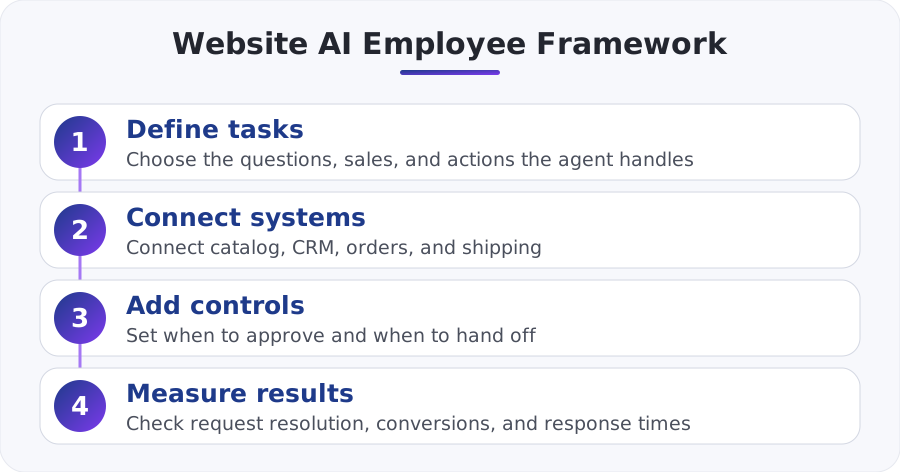
A virtual AI employee for sales and customer service sites is an operational and commercial tool, not a gimmick. When it is built around clear tasks, connected to the right systems, governed by control rules, and measured by results, it can improve 24/7 customer service, reduce team workload, and increase the chance of conversion.
For Israeli businesses, the right starting point is not which bot should we install, but which conversations, actions, and handoffs can be taken off the human team without harming quality. From there, you build an AI agent for sales sites that works like a real employee: available, consistent, documented, and connected to the business process.
Related pages
What wears you out most in your business? Pick one and we'll start there
One click, and the form is already partly filled in.