AI for Predicting Customer Churn Before They Leave
A practical guide for businesses: how AI spots customers at risk from usage, service and payments, and turns churn prediction into real-time retention.
AI-driven customer churn prediction is the ability to identify in advance which customers are at risk of leaving based on usage patterns, service requests, payments, and interactions. Instead of discovering churn in a monthly report too late, the business gets a risk score and an action recommendation at a point when the customer can still be retained.
Why do you even need customer churn prediction?
In most small and medium-sized businesses, customer churn does not happen in a single moment. Usually there is a chain of small signs: a drop in purchase frequency, fewer responses to messages, an unresolved issue, a late payment, or simply lower usage of the product or service. The problem is that the business owner or service manager sees each sign separately, but not always the full picture.
This is exactly where AI comes in. Instead of relying on gut feeling or on a rigid rule like a customer who has not bought for 60 days, the system learns to identify combinations of signals that indicate risk. This is especially important in businesses with many active customers, several communication channels, and information spread across CRM, WhatsApp, billing, and support systems.
A small or medium-sized Israeli business has another good reason to invest in this: the cost of acquiring a new customer is usually higher than the cost of retaining an existing one. That is why AI-powered customer retention is not just a service improvement, but a mechanism that protects recurring revenue, profitability, and stability.
How does AI identify a customer who is about to leave?
The principle is simple: the model is not looking for a single event, but for a pattern. A customer does not have to say they are unhappy to be at risk. Sometimes it is enough to see that in the past month they logged into the system less, opened two support tickets, paid late, and stopped responding to follow-up messages.
What signals usually go into the prediction?
- Reduced use of the product, system, or service
- Lower purchase frequency or order volume
- More service tickets or longer resolution times
- Negative sentiment in messages, emails, or summarized calls
- Late payments, billing failures, or changes in credit terms
- Lower engagement with onboarding or training messages
- A shift from proactive interaction to long periods of silence
The important point is that the model needs to learn what happened in the past. Which customers actually left, and which signs appeared before they did. Even without a data scientist, you can start with a first version using smart risk scoring, and then improve it gradually.
| Approach | What it checks | Advantage | Disadvantage | When it fits |
|---|---|---|---|---|
| Manual rules | One or two conditions, for example no purchase for 60 days | Fast and simple | Misses complex context | Quick start or a very small business |
| Weighted scoring | Several signals with a weight for each one | Good for an initial rollout | Requires manual tuning | SMB with reasonable data |
| AI model | Combined patterns and churn probability | Better accuracy and flexibility | Requires data and measurement process | Business with customer volume and consistent data |
What data is really needed for customer churn prediction?
Many businesses think they need perfect data to start. In practice, in most cases, four basic data sources are enough:
- CRM data: customer status, account owner, contact history, and renewal date
- Usage or purchase data: logins, orders, frequency, average basket size, or feature usage
- Service data: open tickets, handling times, issue types, and satisfaction
- Billing data: late payments, cancellations, payment failures, and plan changes
If this information is spread across systems, the first step is really infrastructure. Before the model, you need to know how to identify a process that fits automation and how to build a data pipeline that does not break every week. In many cases, this starts with connecting business systems with APIs using n8n and Make, or with a more practical approach to connecting CRM, WhatsApp, and invoicing without the mess.
Another important principle is minimum necessary data. You do not need to pull every piece of customer information. You only need what explains churn risk and helps trigger a business response. In terms of governance and privacy, it is worth working according to principles like those in the NIST AI Risk Management Framework: a clear objective, controls, human accountability, and risk mitigation.
How do you implement customer churn prediction in a small or medium-sized business?
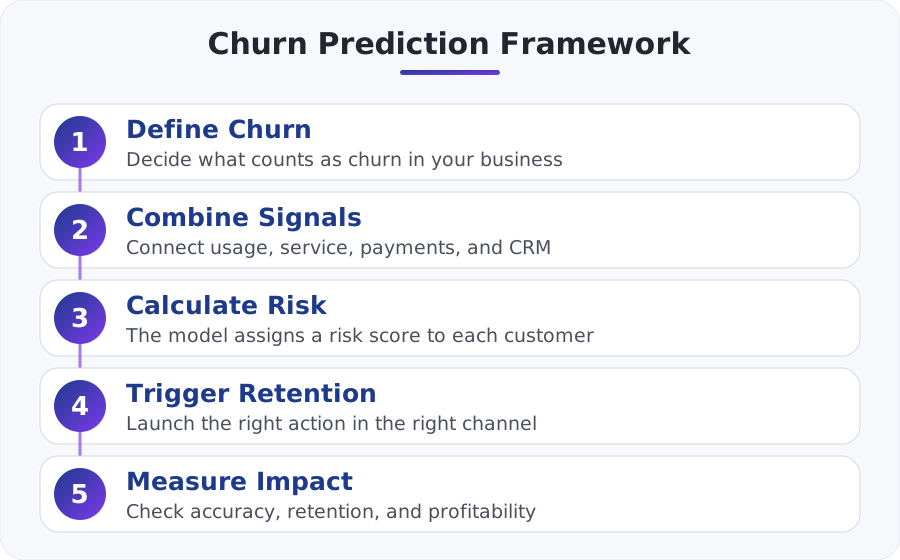
The most common mistake is starting with the model. The correct order is the opposite.
Step 1: Define what churn means for you
Churn looks different in every business. In a SaaS subscription, it may be non-renewal. In a clinic, it may be stopping treatment visits. For a distributor or importer, it may be a sharp drop in order frequency. Without a clear definition, the model will learn the wrong target.
Step 2: Build a basic scoring layer
Before full machine learning, you can start with a simple score: lower usage, more issues, late payment, and no response to messages. This stage helps you check whether you actually have good signals. It also creates a benchmark for a more advanced model.
Step 3: Unify the data and run the first model
You do not need a large data team. In many cases, you can start with a data warehouse and a basic analytics tool, or with solutions like BigQuery ML, which lets you build models directly on the data you already have. The goal at this stage is not academic perfection, but a useful risk score that serves the team.
Step 4: Connect the prediction to action
If the system only flags a customer as at risk and nothing happens, you have not built retention, you have built a report. You need to decide who receives the alert, what the response time is, and what the recommended action is for each type of issue. In businesses where AI decisions affect pricing, offers, or proactive communication, it is also important to define AI governance in business: who approves agent and automation decisions.
What do you do after the model flags a customer at risk?
This is where most of the value lies. Identifying a customer who is about to leave is only the beginning; retention happens in the right action.
If the risk comes from low usage, the best action may be a short training session, a how-to video, a success call, or an onboarding repair track. If this is a service business, you can build a proactive flow through WhatsApp as a business platform for automation and customer service, where the customer gets a personal message, quick scheduling with a representative, and a shorter time to resolution.
If the problem is weak onboarding of new customers, it is better to connect the prediction to new customer onboarding automation in CRM and WhatsApp instead of jumping straight to a discount. A customer who did not understand the value of the product does not always need a price cut; sometimes they need the right activation path.
If the risk comes from payments, the treatment can be completely different: a smart reminder, an installment offer, payment details verification, or a proactive call before a renewal failure. And if the source is poor service, the path should bypass bots and reach a senior representative.
The biggest mistake is to trigger the same response for everyone. AI-powered customer retention works best when the prediction is tied to the likely reason for churn, not just to a numeric score.
How do you measure whether the model actually works?
Many businesses check only whether the model was right. That is not the only question. The business question is whether retention improved.
There are three layers of measurement worth tracking:
- Model metrics: Precision, Recall, AUC, and the rate of false positives versus false negatives. A good explanation of these metrics can be found in the scikit-learn model evaluation documentation.
- Process metrics: How many at-risk customers received treatment, how quickly, and through which channel
- Outcome metrics: How many customers were retained, how much revenue was saved, and what the cost of retention was
A concrete example: imagine a B2B business with 1,200 active customers and a monthly subscription revenue stream. The model flagged 96 customers as high risk. The team chose to focus on the 40 highest-value customers, reached out proactively within 24 hours, and by the end 27 of them renewed or returned to normal usage. If each of them is worth an average of about NIS 1,200 per month, about NIS 32,400 in monthly revenue was retained. That is already a clear basis for calculating ROI.
The best way to measure impact is to compare against a control group, or at least compare against an earlier period when no such retention initiative was running.
What are the most common mistakes in customer churn prediction?
The first is defining churn vaguely. If the target is not clear, the risk score will not be useful either.
The second is relying on only one data point, for example no purchase. Customers leave for a variety of reasons, so a good model must look at usage, service, billing, and communication together.
The third is building a model without a business owner. Someone needs to be responsible for the threshold that triggers treatment, the priorities, and the measurement of results.
The fourth is assuming that every risk flag must lead to a discount. Sometimes a discount hurts margin and does not solve the problem. A customer who feels they did not get value needs value, not a coupon.
And the fifth is neglecting data quality. If the CRM is not updated, if service tickets are not closed properly, or if there is no reliable connection between systems, the prediction will be weak. In other words: a decent data infrastructure is just as important as the model itself.
Summary
AI for identifying customer churn is not meant to impress on a dashboard, but to create early intervention that protects revenue. For a small or medium-sized business, the real opportunity is not necessarily in a complex model, but in the right connection between usage, service, and payment data and fast, measurable action.
If you clearly define what churn means, unify a few key data sources, and build different retention paths according to the reason for risk, you can identify a customer who is about to leave before it turns into an actual cancellation. That is exactly the practical meaning of customer churn prediction: fewer surprises, more control, and AI-powered customer retention that is truly connected to the business.
Related pages
What wears you out most in your business? Pick one and we'll start there
One click, and the form is already partly filled in.