How to Build Automated Marketing Funnels with AI Agents
A practical guide to building automated marketing funnels with AI agents: lead capture, scoring, follow-up, CRM integration, and accurate measurement.
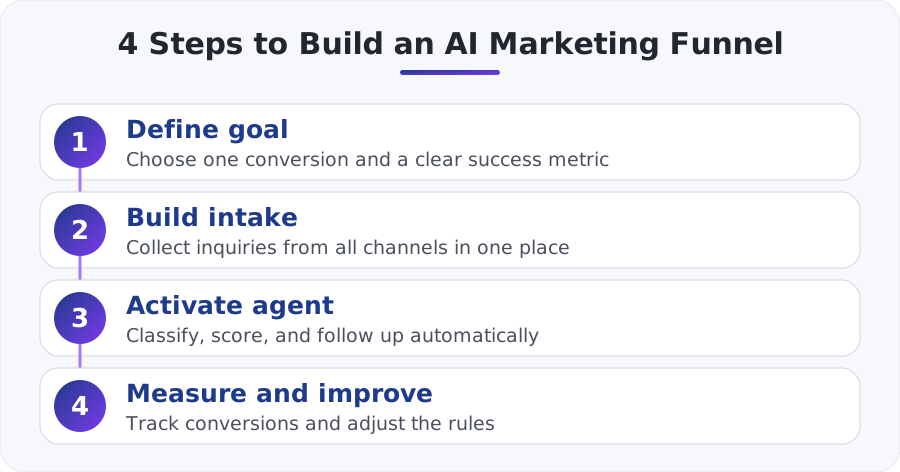
Automated marketing funnels with AI agents work best when you first define one conversion goal, connect every lead source to a single system, and activate an agent that can classify, score, respond, and update the CRM without unnecessary manual work. The key is not 'another bot,' but a measurable business process that shortens response time, improves lead quality, and passes only genuinely sales-ready inquiries to your sales team.
What exactly is an automated marketing funnel with an AI agent?
An AI marketing funnel is a process in which every lead that enters the business goes through a series of automated steps: intake, source identification, intent understanding, scoring, follow-up, and handoff to a representative or a meeting. The difference between a regular funnel and an AI-powered sales funnel is that instead of a rigid if-then sequence, the agent can interpret free text, connect context across different channels, and decide the next step based on the customer’s status.
For example, a lead that arrives through a website form with a general question will get one response, while a lead that comes in through WhatsApp after visiting the pricing page will get a different response, with a more precise next-step offer. This is exactly where it helps to understand the difference between AI agent vs. chatbot: a chatbot replies, while an AI agent also runs logic, pulls data, updates systems, and moves the funnel forward in practice.
When is an AI agent really better than regular automation?
Not every funnel needs an agent. If all you need is to send a thank-you email after a form submission, regular automation is enough. An AI agent comes into play when there is high variability in inquiries, multiple communication channels, or a need for dynamic real-time decision-making.
Before building a system, it’s worth checking how to identify a process that is a good fit for automation. A simple rule: if your marketing or sales teams keep making the same semi-manual decisions over and over — who is a warm lead, who needs a reminder, who is ready for a meeting, who needs more content — then you have a strong candidate for lead automation.
For illustration, here is the difference between a classic funnel and a funnel built with AI agents for marketing:
| Topic | Classic automation | Funnel with an AI agent |
|---|---|---|
| Input type | Fixed fields only | Free text, chat, voice, and documents |
| Lead response | Uniform message | Tailored response based on intent and context |
| Lead scoring | Hard rules | Combination of rules, content, and behavioral signals |
| Follow-up | Predetermined sequence | Next-step selection based on the customer’s reply |
| System connections | Basic | CRM updates, task creation, meeting scheduling |
| Escalation to a person | Usually manual | According to predefined conditions |
How do you build the funnel step by step?
1. Define one conversion that matters to the business
The common mistake is trying to build one funnel for everyone: campaigns, service, sales, cold leads, warm leads, and customer reactivation. That almost always creates a messy system. Start with one conversion: booking a consultation call, requesting a demo, asking for a quote, or making a purchase.
If the goal is not sharp, the agent won’t be sharp either. A good AI marketing funnel starts with a simple question: what exactly do you want to happen after the lead comes in?
2. Unify all entry points
The next step is to centralize all channels into one table or one CRM: forms, landing pages, WhatsApp, Facebook Leads, phone, and website chat. Without a single source of truth, there is no real way to manage automated marketing funnels.
Technically, you will usually need integrations between systems through an API or an automation tool. If you are still evaluating the infrastructure, our guide on how to connect business systems via API using n8n and Make will help you understand how to unify information without duplicates. When you need more flexibility or custom logic, it also helps to understand when n8n beats an off-the-shelf solution.
3. Define what the agent needs to know about each lead
This is where you build the context layer. The agent should receive at least:
- Lead source
- Landing page or campaign
- Time of inquiry
- Message or conversation content
- Existing CRM data, if available
- Current commercial status
At this stage, you can use capabilities such as tool calls and system actions, for example through Function Calling in the official OpenAI documentation, to enable the agent not only to respond, but also to open a task, pull customer data, or schedule a call.
4. Build a scoring and follow-up mechanism
This is the heart of lead automation. Instead of just "lead comes in → send message," build a layer that checks: is the lead relevant, how mature is it, and what is the right next action?
A practical example: a B2B business that receives 40 leads per month out of about 1,000 landing-page visits can define three handling levels:
- Hot lead: requested a demo, mentioned budget, or asked to talk today
- Medium lead: interested but needs more material or follow-up scheduling
- Cold lead: left details without a clear intent
In that case, an AI marketing agent can send the hot lead a WhatsApp message within 2 minutes, offer two meeting slots, and update a sales rep only if the customer replied positively. A medium lead gets tailored content and a clarifying question. A cold lead enters a gentler nurturing sequence. It’s a simple example, but it shows how an AI marketing funnel reduces friction instead of just generating more automated messages.
How do you connect the funnel to CRM, WhatsApp, and measurement?
For the funnel to work in the real world, it must be connected to the business’s core systems. The CRM is the source of truth, the messaging channel is the execution layer, and analytics are the control layer.
In Israeli businesses, WhatsApp is often the fastest channel for closing the gap between a new lead and a real conversation. So if a significant share of your leads prefers immediate communication, it’s worth understanding what a WhatsApp bot and AI agent for CRM integration in Israeli businesses looks like, and how such a channel fits with WhatsApp as a business platform for automation and customer service.
From a measurement standpoint, it is important to implement consistent events from the click stage all the way to the actual conversion. You can rely on the official documentation for events and conversions in Google Analytics 4 and Meta Conversions API to sync conversion data even when not all actions happen in the browser.
The simple rule is this: if the agent sent a message, booked a call, disqualified a lead, or handed it off to a rep — each of those actions should be recorded. Without that, there is no way to know whether the problem is the campaign, the landing page, the script, or the agent itself.
Which metrics really matter?
Many businesses measure only lead volume. That is almost never enough. If the goal is an AI sales funnel that works, it’s worth tracking a set of metrics that connect marketing, sales, and operations:
- Response time to a new lead
- Percentage of leads that passed quality scoring
- Percentage of leads that reached a call or meeting
- Meeting show-up rate
- Cost per qualified lead, not just cost per lead
- Percentage of handoffs to a human out of all conversations
- Closing rate by lead source and by nurturing path
If, for example, response time dropped from 4 hours to 5 minutes but the meeting rate did not increase, the agent may be responding quickly but with a message that is not precise enough. If the scoring rate is high but many leads are being passed to reps unnecessarily, there may be no clear threshold rules.
What are the most common mistakes in building an AI marketing funnel?
Building a 'smart agent' without a clear process
An AI agent does not fix a weak marketing strategy. If the target audience, the offer, and the trigger for moving forward are unclear, the agent will only speed up the chaos.
Running automation without governance and escalation
A good funnel must know when not to reply, when to hand off to a person, and who is authorized to approve a sensitive action. On this topic, it is also worth reading about AI governance in the business: who approves agent and automation decisions, because a funnel that works without boundaries is also a business risk.
Training the agent on marketing messages instead of operational knowledge
The agent needs access to messages, FAQs, pricing, service terms, hot-lead definitions, and handoff rules for a sales rep. Without that, it may sound 'smart' but it won’t really drive conversion.
Forgetting that the goal is improving conversion rate, not just saving time
Yes, AI agents for marketing save manual work. But the real test is whether more qualified leads reach the next step with less friction. That is what separates elegant automation from a funnel that actually drives growth.
What does a good setup look like for an Israeli SMB?
In most small and medium-sized businesses, the most effective setup is not the most complex one. Usually, a structure like this is enough:
- Traffic source: campaigns, SEO, referrals, or content
- Intake layer: form, WhatsApp, chat, or phone
- Automation engine: n8n, Make, or a similar system
- AI agent: lead scoring, response drafting, clarifying questions, next-step scheduling
- CRM: status management, tasks, owners, and dashboard
- Measurement: GA4, pixels, server events, and sales reports
That’s it. You do not have to start with more than this. In practice, good automated marketing funnels are usually simpler than people imagine — but far more precise.
Conclusion
To build an AI marketing funnel that delivers results, you need to think less about a 'smart agent' and more about a complete business process: a clear conversion goal, consistent data collection, lead scoring, multichannel follow-up, CRM integration, and real measurement. When done right, AI agents for marketing do more than reply faster — they move leads through the funnel in a more consistent, measurable, and profitable way.