AI for Dental Clinics: Appointments and Patient Follow-Up
A practical guide to using AI in dental clinics for scheduling, reminders, cancellations, patient follow-up, WhatsApp, CRM, privacy, and KPIs.
Yes—AI implementation in dental clinics works best when it starts with clear administrative processes: appointment scheduling, reminders, cancellations, and patient follow-up. Instead of replacing the clinic team, an AI agent connects to the calendar, CRM, and communication channels, acts according to defined rules, and escalates only exceptions to a human.
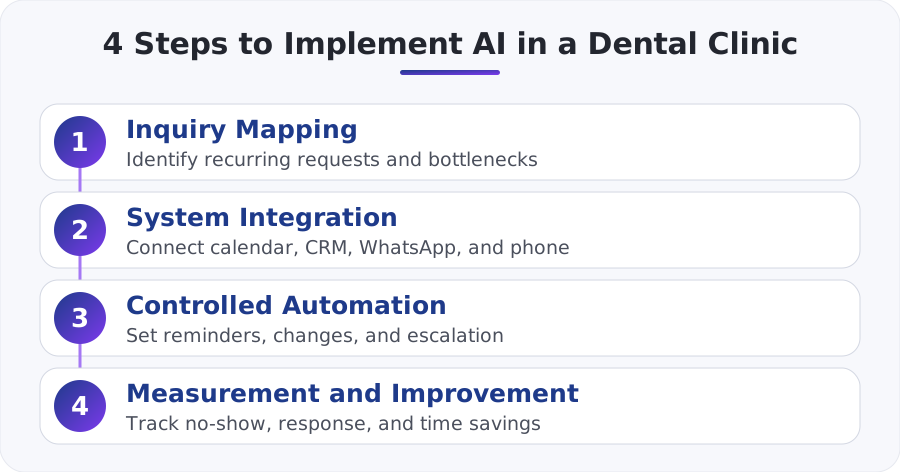
Why should AI implementation in dental clinics start with appointments and follow-up?
In a dental clinic, the daily workload comes not only from treatments but also from a huge volume of repetitive communication: patients who want to book an appointment, change a time, confirm attendance, ask what to bring, or report after treatment that they are still in pain and want someone to call them back. These are high-volume, repetitive, and operationally sensitive processes—exactly where clinic automation delivers value quickly.
The important point is to distinguish between a tool that displays answers and a system that actually does the work. If the difference is still unclear, it’s worth reading the explanation of AI agent vs. chatbot: a clinic does not need just a bot that says a representative will get back to you, but an AI agent that can check availability, suggest alternatives, update status, and record the conversation in the system.
Simply put: less manual work at the front desk, less back-and-forth with patients, and more control over the calendar.
Which processes should be automated first?
The common mistake is to start with a solution that is too broad. In practice, AI should be implemented in stages, according to the order of value and risk:
1. Initial appointment booking
The AI agent collects the type of treatment, the requested doctor, the preferred time range, and contact details, then offers available slots according to predefined rules. If human approval is needed, it opens a structured request instead of leaving a free-text message.
2. Arrival confirmations and reminders
This stage is the foundation. Instead of a one-way reminder, a two-way process is better: 'confirm,' 'need a different time,' 'cancel.' That way, the clinic is not only reminding patients, but also taking action in real time.
3. Rescheduling and cancellations
This is where much of the operational savings are found. A patient who wants to reschedule does not need to wait for the clinic to open; the agent can offer 2–3 alternatives from the calendar, update the appointment, and free up the slot for others.
4. Post-treatment follow-up
After an extraction, implant, or complex treatment, you can send an automated follow-up message with a simple status question, a link to pre-approved instructions, or a request for the team to call back if there is an unusual report. Important: this is operational and service follow-up, not automated medical diagnosis.
5. Recall for existing patients
Periodic scaling, a six-month checkup, or returning to an unfinished treatment—these are processes many clinics manage manually or not at all. This is where AI agents can work in a systematic and measurable way.
What does a proper end-to-end workflow look like?
A good implementation does not start with the question of which AI model to choose, but with the question of what action we want to happen without human intervention. A proper process looks like this:
- Inquiry intake – WhatsApp, form, phone call, or website.
- Intent detection – booking, rescheduling, cancellation, administrative question, or request for a callback.
- Data check – patient identification, relevant doctor, treatment type, and calendar availability.
- Action execution – scheduling, changing, sending a document, opening a task, or escalating to a representative.
- Logging and follow-up – updating the CRM or management system and sending a follow-up message.
This is exactly where the right connection between systems changes the outcome. If you are evaluating the architecture, the guide on how to connect business systems via API using n8n and Make provides a useful framework, and at the same time it is important to understand how to connect CRM, WhatsApp, and invoicing without a mess in order to prevent duplicates and documentation errors.
Which systems must be connected for this to really work?
AI without integration is only a conversation layer. In a dental clinic, the minimum usually required is:
- Appointment calendar – the source of truth for availability.
- CRM or patient management system – patient details, statuses, history, and permissions.
- WhatsApp Business – a preferred channel for many patients in Israel. You can work through Meta’s WhatsApp Business Platform documentation.
- Telephony – for those who prefer a call or when a patient does not respond to messages. If the phone channel is central for you, also read about a Hebrew AI voice bot for business phone agents.
- Secure forms and links – for example, collecting details before treatment or requesting approval.
- Audit log – who sent what, what was sent, who approved it, and what was escalated to a human.
Without this connection, even a good AI agent will get stuck on the most important step: taking real action, not just writing a nice message.
What is the difference between regular reminders and a real AI agent?
The following table summarizes the operational difference:
| Capability | Manual reminder | Basic reminder system | AI agent connected to systems |
|---|---|---|---|
| Sending a reminder | Yes | Yes | Yes |
| Patient response in the same channel | Partially | Partially | Yes |
| Automatic rescheduling | No | Usually no | Yes, according to rules |
| Checking calendar availability | Manually | No | Yes |
| CRM logging | Manual | Partial | Automatic |
| Identifying exceptions | Depends on staff | Limited | Yes, with escalation |
| Follow-up after treatment | Manual | Partial | Yes, in defined scenarios |
In practice, the business difference is not just what is sent to the patient, but how much internal work is saved for the team.
How do you maintain privacy, control, and reliability?
In a medical setting, even if the goal is operational rather than clinical, there is no room for careless implementation. Here are the basic rules:
Keep data to a minimum
Not every process needs to expose full medical information. An appointment reminder or attendance confirmation request does not have to include diagnostic details.
Define what AI can and cannot do
An AI agent can manage appointment scheduling and service follow-up, but it should not provide independent medical advice. If a patient writes about unusual pain, swelling, or bleeding, the right response is to trigger an immediate escalation rule to the team.
Work with permissions, logs, and approved templates
Messages before and after treatment should be approved in advance, with orderly tracking of every action. From a governance and control perspective, it is recommended to adopt principles from the NIST AI Risk Management Framework and also define in advance who approves agent and automation decisions.
Check the communication channel for compliance
Even if the clinic is in Israel and does not operate under HIPAA, the principle is still the same: reminders and messages should be proportionate, secure, and clear. You can learn from the U.S. Department of Health & Human Services guidance on appointment reminders.
A practical example: what does this look like in an Israeli clinic?
Let’s take a clinic with 3 treatment chairs, 2 doctors, and 700 appointments per month. If only 12% of appointments require a change, cancellation, or reconfirmation, that means 84 interactions per month. If each such interaction takes an average of 5 minutes of front-desk time, that is already 420 minutes—7 hours per month just for handling changes, without counting missed calls, follow-ups to patients, and data entry in the system.
In a proper implementation, the agent sends a reminder 48 hours before the appointment, asks for confirmation with one click, and sends another reminder only to those who did not respond. If the patient wants to reschedule, the agent checks available slots with the same doctor or according to an alternative rule, suggests times, and updates the calendar after approval. After a complex treatment, a follow-up message is sent in the evening or the next day with the option to request a call back from the clinic.
This is not a futuristic scenario; it is simply a well-managed operational chain. If you are in the evaluation stage, it is also worth understanding how much a WhatsApp bot costs for businesses, because the real cost is affected not only by the bot itself, but also by message volume, integration depth, and the scope of automations.
How do you measure success in the first 90 days?
If there are no metrics, there is no implementation—only a feeling. In a dental clinic, you should measure at least:
- Average response time to a new inquiry
- Appointment confirmation rate before arrival
- Rate of change requests handled without human intervention
- Reduction in the number of messages and callback requests to the front desk
- No-show rate before and after deployment
- Number of aftercare follow-ups sent and completed
- Number of cases escalated correctly to the team
A great indicator of a strong implementation is not just how many messages were sent, but how many real actions were completed end to end without unnecessary human delay.
Summary
AI implementation in dental clinics does not have to start with a complex system or a long project. In most cases, the fastest value is found in appointment scheduling, arrival confirmations, calendar changes, and patient follow-up after treatment—provided the agent is connected to the right systems, operates according to clear rules, and is designed in advance with controls and permissions.
The right approach is to start small but connected: choose 2–3 repetitive processes, connect the calendar and CRM, define escalation rules, and then measure the real result. That is how clinic automation turns from a technological gimmick into an operational engine that improves both patient experience and clinic efficiency.
Related pages
What wears you out most in your business? Pick one and we'll start there
One click, and the form is already partly filled in.