WhatsApp Cart Abandonment Messages
What can e-commerce businesses send on WhatsApp in 2026, and how can you build abandoned cart automation that recovers sales without blocks or policy issues?
WhatsApp abandoned cart messages can bring back lost sales, but only if they’re built correctly: with clear consent, proper use of templates, accurate timing, and a real connection between the store, the CRM, and WhatsApp Business Platform. In 2026, the key question is not only how to send, but what is allowed to send on WhatsApp and when, because a small mistake can hurt both conversion and your number’s quality.
Why do WhatsApp abandoned cart messages work better than other channels?
A customer who abandoned a cart is at a hot friction point: they already chose products, sometimes even entered details, and then stopped. In this situation, WhatsApp is a stronger channel than email in many cases because it is direct, fast, and read almost immediately. But the real advantage is not just the open rate; it is the ability to bring the customer back to the exact point where they stopped.
That means a good abandoned cart message is not just a reminder. It should include:
- Clear context about what was abandoned
- A direct link to the cart or checkout
- A short, simple message
- An option for human or automated response if there is a question
If you are still shaping this channel’s role in operations and sales, it helps to first understand the bigger picture of WhatsApp as a Business Platform for Automation and Customer Service. Abandoned cart messages are not a single marketing trick; they are part of a working system.
What is allowed to send on WhatsApp in 2026?
This is where most businesses go wrong. They treat WhatsApp like SMS or like a broadcast tool, and then find out too late that their template was blocked, their number quality dropped, or customers simply marked the message as unwanted.
The practical rule is this: if it is an initiated business outreach outside an open conversation window, you do not send free-form text. You send an approved template and only in a context that matches the consent you received and the policy. Meta publishes official documentation on Message Templates and Business Policy, and that is where you should start before any automation.
Put simply, an abandoned cart message should be built as a legitimate business event, not as a marketing message in disguise. In addition, in Israel you also need to consider the nature of the consent and the message in light of local law. If you do not have clear, documented opt-in, do not rush to activate automation.
Quick decision table: What can you send?
| Situation | What you send | What is required | Risk level |
|---|---|---|---|
| The customer opened a chat or replied recently | Free-form, relevant message | Follow policy and answer in context | Low |
| The customer abandoned a cart and there is no open window | Approved template | Documented consent and a focused message | Medium if built correctly |
| There is no clear consent or the number source is invalid | Do not send | First establish opt-in and documentation | High |
| You want to push a blanket promotion to every abandoner | Not as a first step | Segmentation and proper usage approval | High |
If you are also reviewing cost alongside policy, check out WhatsApp service message pricing for businesses in Israel after Meta’s 2026 changes. In an e-commerce business, the profitability of the flow depends on both operational approval and sending economics.
How do you build the right abandoned cart automation?
The common mistake is starting with the text. In practice, you need to start with the architecture.
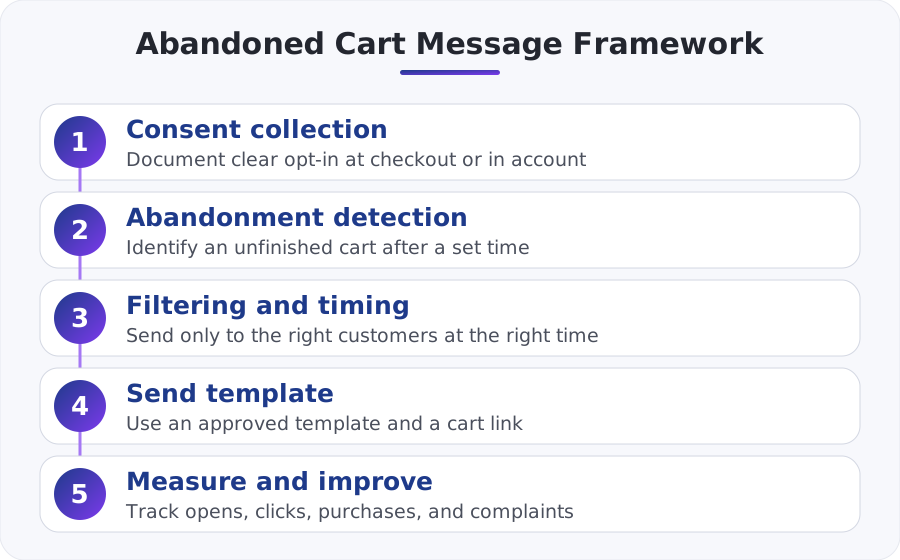
The right flow looks like this:
1. Collect consent in the right place
Consent should be collected at checkout, in the account area, or in another relevant form, in clear language. Do not bury it deep in the terms. Record the source, time, wording, and channel, so if you ever need to verify what was approved and why, you have proper proof.
2. Detect real abandonment
Not every unfinished cart is abandonment. Someone who moved to the shipping page and came back after 6 minutes does not necessarily need a message. On the other hand, a customer who added items, entered a phone number, reached checkout, and did not complete it for 30 to 60 minutes is a better candidate.
3. Filter before sending
Do not send to everyone. It is worth filtering by:
- A valid phone number
- Documented consent
- A minimum cart value that makes sense for the business
- Available stock
- No purchase already completed through another channel
- Complaint history or opt-out status
4. Connect systems without manual work
The store, CRM, WhatsApp, order system, and analytics must talk to each other. Otherwise, you will send an abandonment message to a customer who already bought, or miss a reply received on WhatsApp that was never recorded in the CRM. If that sounds familiar, read how to connecting CRM, WhatsApp, and invoices without the mess.
5. Document responses and the next step
The moment the customer replies, the game changes. Now you can move them into a service, sales, or human-assistance path. This is where the value of WhatsApp bot and AI agent for CRM integration in Israeli businesses comes in: not just sending a message, but understanding who replied, why they hesitated, and what should happen now.
What message sequence should you send for an e-commerce business?
There is no single sequence that fits everyone, but there are good principles. For an Israeli SMB, it is better to start small and precise, not aggressive.
Practical example:
Let’s say a customer added two items worth NIS 289 to the cart, entered a phone number, and stopped after the shipping step.
First message after 45 minutes
A short, focused message with a direct link to the cart. No coupon, no pressure, no three-line marketing pitch.
Possible wording at the principle level:
Hi, we noticed your cart is still waiting. You can go straight back to complete your order here: link.
Second message after 18 to 24 hours, only for those who did not buy and did not ask to stop
Here you can check whether the obstacle is operational: shipping, sizes, payment method, stock. The message should open the door to help, not just push a purchase.
Third message only in certain cases
For example, in high-value carts, a brand with strong loyalty, or when the customer has already interacted. For most stores, three messages to every abandoner is too much.
The important principle: do not give an automatic discount in the first message. If every abandonment gets a coupon, you train customers to abandon in order to get a better price.
Which message templates actually work?
Good abandoned cart messages are not especially creative. They are clear. A customer who abandoned a cart does not need flashy copy; they need confidence, context, and a shortcut.
What usually works:
- First name, if available
- A general mention of the cart or product
- A direct completion link
- An offer of human or automated help
- Very short wording
What usually hurts performance:
- Too many emojis
- Pushy wording like don’t miss out
- A discount too soon
- Long text that feels like a campaign
- A message that does not explain why they got it
To understand the cost and planning side as well, you can compare it with how much a WhatsApp bot costs for businesses. This matters because profitable cart recovery is measured by net profit after infrastructure cost, not just by the number of messages sent.
How do you measure success without bothering customers?
If all you measure is how many people received a message, you do not have a system. You just have sending.
The metrics that really matter:
- Delivery rate
- Open rate, if available through your measurement tools
- Click-through rate to the cart link
- Purchase recovery rate
- Time to purchase
- Human response rate that required handling
- Opt-out or complaint rate
- Average order value of those who returned through WhatsApp
The most critical metric for most small and medium-sized stores is not just recovery rate but net recovery: how much revenue actually came back after subtracting platform, development, operations, and discount costs.
This is where AI can help, but not instead of business logic. For example, an AI agent can classify replies like the link doesn’t work, there’s a different size, or I need an invoice, and route each request to the right path. On the other hand, if your basic flow is not legal, not documented, or not connected to systems, AI will only speed up the mess.
What are the most common mistakes?
-
Sending to anyone who has a number
A phone number is not consent. -
Not distinguishing between a service message and a marketing message
Do not try to disguise aggressive selling as a support message. -
No real-time synchronization with orders
That is how messages get sent to customers who already purchased. -
No business owner for the process
Marketing writes, operations sends, service replies, and nobody owns the result end to end. -
Starting with the tool instead of the policy and the flow
Choosing the platform is important, but first you need to decide what counts as abandonment, who is eligible for a message, and how consent is documented.
Summary
WhatsApp abandoned cart messages for e-commerce businesses should not be just another distribution channel. They should be a precise process for recovering sales: consent, abandonment detection, filtering, the right template, smart responses, and real measurement.
The right approach in 2026 is not to ask only how to send a message, but to build a mechanism that brings back purchases without risking blocks, without overwhelming customers, and without creating chaos between the store, the CRM, and the team. If this process is built correctly, WhatsApp for ecommerce becomes a measurable, controlled, and profitable conversion tool.
What wears you out most in your business? Pick one and we'll start there
One click, and the form is already partly filled in.