ChatGPT Ads: GEO and Lead Automation
What ChatGPT ads mean for Israeli businesses, how they reshape GEO, and how to connect them to lead automation, CRM, and WhatsApp without losing tracking.
ChatGPT ads are changing the game because they insert a commercial layer directly into a conversation with high search intent. For businesses, that does not replace GEO; it sharpens it: anyone who is not built well organically and connected to lead automation will pay more and convert less.
What Actually Changes When ChatGPT Starts Showing Ads?
Until now, most business owners thought about AI visibility mainly through organic appearance in answers. Now an additional layer is coming in: sponsored offers inside or around the conversation experience. Even if OpenAI’s ad format is still expanding gradually and changing from market to market, the direction is very clear — ChatGPT is becoming not only an answer engine, but also a commercial discovery surface.
This is an important shift because conversational search is different from classic search. In Google, users are used to scanning a list. In ChatGPT, they get a synthesized answer, context, and sometimes also a recommendation or a next action. That means attention is split differently: not between 10 links, but between the answer itself, the sponsored element, and the next action the user is asked to take.
OpenAI has already made it clear that it sees ChatGPT as a search and discovery layer, as described in Introducing ChatGPT search. From a marketing perspective, that means a business needs to think about three things at the same time: visibility in the organic answer, readiness for paid advertising, and a fast conversion path after the click.
How Do ChatGPT Ads Affect GEO?
The most common mistake is to think that once paid advertising exists, GEO becomes less important. In practice, almost the opposite happens.
Good GEO is what increases the chance that your brand, solution, or website page will be clear to AI engines even without payment. If an ad appears in a conversational interface and sits next to an organic answer, the user will compare the credibility of the sponsored message with what the model has already “understood” about you from the internet. If you do not have a clear, consistent, and authoritative presence, you will pay to bring the click but lose on trust.
That is why ChatGPT ads do not weaken GEO; they raise the cost of weak GEO.
In practice, good GEO for this kind of topic includes:
- Focused service pages with clear, non-vague marketing copy.
- Questions and answers that address real search intent.
- Trust signals: clients, processes, SLA, information security, integrations.
- A technical structure that makes it easy for AI engines to understand the site.
- Consistency between the website, company profiles, and professional content.
If you want to go deeper into this foundation, it is worth reading our guide on How to appear in ChatGPT answers and AI search engines. Technically, Google also continues to emphasize the importance of structured, machine-readable information in Structured data basics, and this principle is also relevant in practice for broader visibility in AI engines.
Here is the distinction that matters:
| Component | Organic GEO | ChatGPT Ads | What it means for the business |
|---|---|---|---|
| Goal | Appear in the answer or as a trusted source | Buy visibility at the intent stage | You need to combine trust with exposure |
| Control | Partial, based on quality and authority | Higher, based on budget and settings | Without an organic base, effective cost rises |
| Message | Information, comparison, explanation | Offer, differentiation, CTA | The message must be consistent across both |
| Measurement | Harder, sometimes indirect | Easier at the campaign level | You must connect it to lead quality, not just clicks |
| Risk | Invisibility | Low-quality clicks | Automated filtering becomes critical |
Why Does This Matter for Lead Automation?
Because a lead that comes from a ChatGPT conversation is usually a lead with richer context — and sometimes also with a higher expectation of a short response time.
A user asking ChatGPT “which automation solution fits a small service business?” or “how do I connect CRM to WhatsApp?” is already at a more advanced stage than someone who only typed a generic keyword. If you send that person to a crowded landing page, a long form, or a manual reply a day later, you lose a valuable advantage.
That is why lead automation around ChatGPT needs to be short, clear, and immediate:
- Identify the source of arrival: ad, organic answer, or AI engine referral.
- Capture lead details with minimal friction.
- Classify by business type, size, urgency, and budget.
- Create a record in the CRM and assign an owner.
- Trigger an automated follow-up: WhatsApp, email, or call.
Here it is also important to understand the difference between a basic chat interface and a system that can actually continue a business process. We covered this in AI agent vs. chatbot: what is the real difference. If you want to turn a click from a conversation into a lead that is captured, classified, and handled, you usually need an agent or automation with system integrations — not just a nice chat window.
For most businesses in Israel, the natural follow-up path will be WhatsApp and CRM. So it is also worth seeing how to build a WhatsApp bot and AI agent for connecting CRM in Israeli businesses, especially if you want a smooth transition from the ad conversation to an operational conversation.
What Does a Proper Lead Funnel Look Like for an Israeli Business?
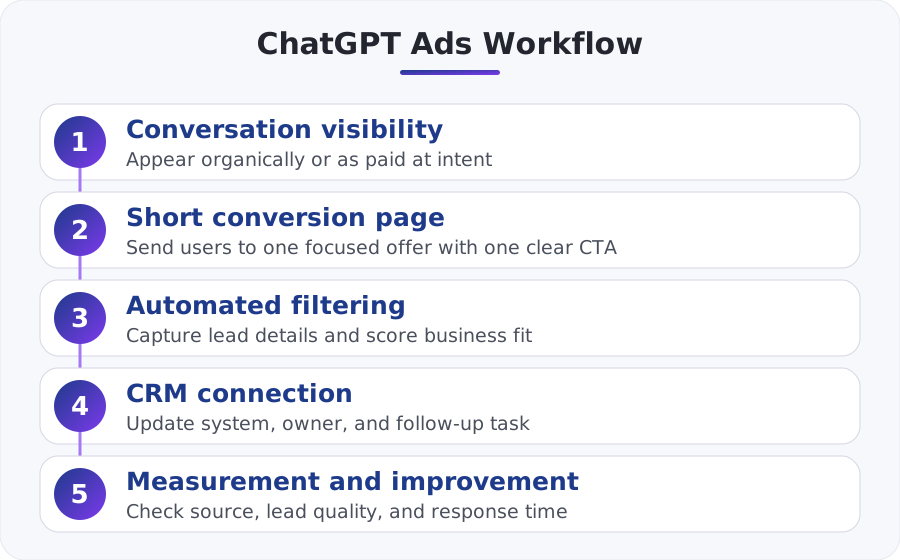
A proper funnel for ChatGPT ads needs to be shorter than a classic PPC funnel, because the user is already coming from an explanatory interaction. Instead of “home page > service page > form > rep,” you need to think in terms of “answer > offer > filtering > follow-up.”
A practical example: let’s say a business sells automation services to service centers. The user asks ChatGPT: “How can I connect WhatsApp, CRM, and invoices without the mess?” If the business appears organically or via paid placement, the next page does not need to explain the entire world. It needs to provide:
- One sharp headline about the outcome.
- 3 pains the business solves.
- One CTA: book a call or start a WhatsApp conversation.
- 4 fields at most: name, phone, company, need.
From there, the automation continues:
- Create the lead in the CRM.
- Tag the source as ChatGPT.
- Send an opening message with 2–3 filtering questions.
- Create a task for a salesperson if the lead meets the threshold.
- Send relevant material automatically if the lead is not ready yet.
In a simple numerical example: if 1,000 impressions in the ChatGPT layer generate a 2.5% CTR, you get 25 visits. If the follow-up page converts 24% into a conversation or submitted details, you get 6 leads. If half of them pass the initial filter, you are left with 3 quality leads. In a B2B business with an average deal of 6,000 to 15,000 NIS, even that small volume can justify a pilot test — provided the automation is built correctly.
If your process is still spread across forms, spreadsheets, and separate accounts, start with our guide on Connecting CRM, WhatsApp, and invoices without the mess. In some businesses it is even worth adding a voice layer, for example when a hot lead needs a quick callback; in that case, the article on Hebrew AI voice bot for business phone agents is also relevant.
What Should You Check Before Launching a Campaign Like This?
Before spending a shekel on AI ads, you need to check that your business system can actually absorb the demand.
1. Do you have one clear offer?
If a user comes from ChatGPT, they do not want to guess what you do. The message must be sharp: solution, target audience, and outcome.
2. Is the conversion page short?
Not a home page. Not a catalog. Not a general article. A focused page that matches exactly the question the user came from.
3. Is the source of traffic measured?
You must save source, campaign, and sometimes also the ad copy or audience. Without this, you will not know whether you got leads or just curious clicks.
4. Is there automated filtering?
Not every lead from ChatGPT is a good lead. One right filtering question can save hours. If you have not yet mapped which processes are even suitable for automation, start with How to identify a process that is a fit for automation.
5. Have agent action boundaries been defined?
If an AI agent sends pricing, schedules meetings, or triggers processes on behalf of the business, you need to decide who approves what. This is especially critical in advertising, because speed without control creates expensive mistakes. On this topic, it is also worth reading AI governance in business: who approves agent and automation decisions.
Will ChatGPT Ads Replace SEO or Google Ads?
No. They will add a new competitive layer on conversational search intent.
A smart business does not choose between SEO, GEO, Google Ads, and ChatGPT Ads as if these were separate worlds. It builds a system in which each layer supports the next:
- SEO and GEO create authority and brand understanding.
- Paid ads buy visibility at commercial moments.
- Lead automation turns interest into action.
- CRM and the AI agent make sure the lead does not fall through the cracks.
The winner will not be the one who spends only more budget, but the one who connects visibility, intent, and operations correctly.
Conclusion
ChatGPT ads are not just “another media channel” — they change the structure of the user journey: from comparing links to a conversation that leads to action. That is why their real impact is measured not only by reach, but by whether your business is ready to appear properly in AI, present a sharp message, and connect the click to an automated, measurable lead path.
For Israeli businesses, the implication is clear: do not wait for the final ad format. Prepare the GEO layer, the conversion pages, and the automation that receives a lead from a conversation and moves it quickly to CRM, WhatsApp, or the right rep. That is what will determine whether ChatGPT is just a curious traffic source for you — or a real growth engine.